Thursday, September 26, 2013

Business and social responsibility

This week I wanted to blog on social responsibility.  When we think about sustainability we often think about things like: Is it organic? Can we recycle it? Where did it come from (in terms of travel miles)? How much waste was created producing it? However, what is equally important is the human side.  Does the product come from a business that shows social responsibility? Does the business look after their staff and allow them to meet the
9 fundamental human needs by Max Neef? Does it exhibit other social responsibilities like volunteering, charity support and philanthropy?    Equally important to this, is that the business you work in/on/for or own also has this strong sense of social responsibility.  


Image source


This link shows a short video clip of the slave labour often employed in food production.  Its based in USA but when I think of New Zealand, unless things have changed drastically from the 1990's when I last had any primary contact with this industry, it may be not so different here. Clothing production worldwide will be similar.  

Now I know you are wondering what this has to do with the Animal Care Industry.  Well many of our products are imported from overseas where we have little idea of the production company and their practices around human resource management.  What I am suggesting is that it is time we found out by starting to ask questions.  

Food for thought?  I look forward to your comments.


Thursday, September 19, 2013

Where have all the bees gone?

Being a keen gardener, I have often asked myself this very question.  As a child I can remember our garden being full of bees, now I rarely see a honey bee.  I still see bumble bees but I'm not sure there are enough to complete the pollination required for my garden. 

So when I stumbled across this TEDTalk it answered lots of questions (and confirmed some suspicions). 

Marla Spivak: Why bees are disappearing

All is not lost - if we all do our bit to plant bee-attractive gardens and hedgerows, the bees will come back. 

Let me know what you think.  Do you have many bees? If you do, what do you have in your garden to attract them? 

I look forward to your comments.


The recent windy weather front

Last week's weather front brought tremendous winds which has created havoc for many.  Many consumers were without power for a week. Its at times like these we realise how much we rely on electricity.  


Image source


What relevance does the weather have to this blog?

Well with the current changing weather patterns we can expect more freak weather storms like this.  So we have to start asking how we maintain power so our home or workplace can keep functioning.  The mind set of relying on the power provider is not going to work long term because eventually the problem has the potential to become too big. Just consider the losses to a business from 1 week closure, yet alone longer.  Insurance may cover it but eventually insurance premiums will rise out of the reach of many. 


Important questions for all homeowners and business owners to ask themselves are:

  1. How long can I survive without power - at home, in my workplace?
  2. What losses will I incur in a time without power? Am I am prepared to take those losses?
  3. What changes to my power supply can I make which will allow me to be self sufficient all the time or at least in the event of mother nature intervening?
  4. Is my alternative source of power sustainable long term? e.g. is it from an infinite resource and will it survive wild winds and earthquakes? 
I look forward to your thoughts on this.

Thursday, September 12, 2013

Why is there concern about urban sprawl?

This article appeared in the Christchurch Press this week.  It is a perspective article discussing something we hear a lot about but often feel powerless to do anything to address the problem - I'm guessing this is partly because of our own 'quarter acre of paradise' upbringing and our wish to replicate this. 
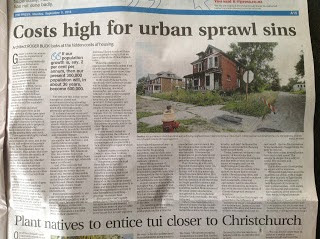


The experts tell us that pushing the city boundaries further out from the town centre is a bad move.  Then they go on to tell us how we should be living in well designed apartments closer to the city centre with communal areas outside for gardens.  The argument sounds very sound and it is easy to go yeah we should do that BUT urban sprawl continues and kiwis want someone else to live in the apartment while they continue to live in large houses with back yards.  The ironic thing is that when you look at nearly every new subdivision popping up around the city, the houses are large and the sections are small (ranging in size from around 400m2 to 800m2). So what we in effect have is a big house with a fence around it and very little viable area to garden or play.  Each of these new subdivision has a entry area with a wall or fence with the name inscribed on it.  The residents enter the subdivision, in their car, drive into their garage and close the door.  Inside they stay because there is no communal outside area. They stay inside engaging with their computers and TVs, out of touch with the neighbourhood around them. These are broad generalizations but you get the gist. 

Not all people are happy living in apartments, and the current subdivision trend isn't meeting the dream for the quarter acre paradise. Many people are generally unhappier in today's urban sprawl and my theory is that it is due to a lack of meaningful interactions. Perhaps we need to stop looking at our old expectations or what other countries are doing and look instead at how we can design a modern living space for a number of people that allows everyone access to the kiwi dream while also promoting community interaction as well as personal and social productivity.  In the future, travel will be more expensive so if people work in an urban sprawl they will need to be able to also live in that area so accessing food locally will be more important than ever. And then of course power - lets be brave and make solar power the only way to access power in these new developments.

Imagine a subdivision where a number of houses all looked over a green space which had multiple uses - the perimeter had fruit and nut trees, a community garden, free-ranging hens where the residents can collect eggs, an area to play ball sports, picnic tables and swales to collect water overflow after rain, yet each of these houses also had their own space for a private entertaining as well.  These houses could be 2-storey, to maximise land use, all could have photo-voltaic panels, water storage tanks and composting toilets.  The kitchen /dining area would be designed to look over the common green space so people could see who was out and about and go out and join in.  Perhaps there could be an office pod, so even if you work from home, you could go to the pod and join others working from home.  The next step to this is of course more radical ideas, like car sharing in these subdivisions distant from the city.

What is to become of the city centre? Well there will always be a core of people, that love the European lifestyle, who will take to that and feed the city centre making it attractive and different so it becomes a place to visit too. 

So, what on earth has all this got to do with veterinary clinics?  Well part of designing these communities we need to consider the core service providers. In this community, perhaps 1 or 2 vets, doctors, dentists (with their support staff) set up a GP style business in each of these areas (another way the community can 'live, work and play' in the same area).  These service providers could offer the basics and a transport service to a central hub for more complex procedures (e.g. large human hospital , or a central large referral hospital for vets).   In some ways, this type of set-up gets back to the community health professional model of years a go when everyone knew the local veterinarian and his or her support staff and they were a pillar of the community.   

What do you think?  Does this model provide a sustainable solution to urban sprawl?  Do we need to go European or do we go for a kiwi approach to sustainable living?  What would your vision be for a kiwi approach to sustainable living?  How do we integrate sustainable veterinary professional services into that vision

I look forward to your ideas and feedback.  


Thursday, September 5, 2013

The importance of sleep

I am inspired this week to write about sleep after stumbling upon a TEDTalk that discussed the importance of sleeping well.  This was preceded by a week or so ago reading an article on it.  It feels like someone is trying to tell me something!

The more I read and think about it, the more I know how important good sleep is and how I haven't been prioritising it as much as I should have.  I think you hit a certain age and you really start thinking about what do you need to do to maximise the time you have and this is really one of those things!

To function well, to be even tempered, rational, make good decisions, and be efficient, you need to have had enough sleep.  However, modern times are trying to convince us more and more that less sleep is OK   The draw of light bulbs, 24 hour TV, 24 hour entertainment, long working days and then trying to get some me time and so on.  I even read recently that 1/3rd of us will fall asleep at the wheel sometime in our lives as a result of sleep deprivation. It is scary to think that many people are out there driving sleep deprived!

It doesn't matter what your role and interests in life.  Without a certain amount of sleep the stakes are high!

Falling asleep again - image source


Thursday, August 15, 2013

Bring back the Milk man

This week its idea sharing time

I am going to share my idea for creating a more sustainable community, and in return I ask that you share yours.

Remember we are thinking environmentally, socially and financially. This 6 petal flower diagram is useful to visualise how these aspects are connected when thinking about what denotes sustainable practice. 


My idea is to reinstate the local milk truck 

Instead of delivering bottles (glass or plastic), the milkie brings round a vat and you go out and fill your jug or bottle and pay for the volume you take.  Initially due to current rules and regulations this would be offering only pasteurised stuff, but then potentially as laws changes A2 and raw...... who knows. 

How cool would it be to bring the milkie back.  The milkie could also deliver  fresh bread and other local produce and maybe even other stuff. For example,  the local veterinary clinic could get them to deliver food ordered online by their clients for example.

Of course the milkie would use a highly efficient, electric vehicle and will have EFT POS facilities. 


NZ Milkman, Circa 1980's. Image source


There are many advantages to this system:
  • Provides fresh milk delivered to your door
  • Supports local businesses
  • Reduces the number of plastic milk bottles going to landfill or recycling
  • Ensures the milk stays in the dark until it is delivered to the end user (in the vat) and then the end user can put it in the fridge (just in case it really is true that milk kept in the dark tastes better). 
  • Avoids many daily trips to the supermarket made by the majority of people who tend to buy milk and bread and other fresh items several times a week - reducing our reliance on fossil fuels
  • Gets the neighbours out on the street talking to each other with a daily meeting point around the milk truck. Who knows what great ideas could stem from those daily meetings. 
  • Employs a local person to be the milkie
What idea do you have that could help to create a more sustainable community?  

Now I am really looking forward to all your ideas!!

Have a great week.


Thursday, August 8, 2013

The benefits of greening your building

Green buildings are good for your people and good for the bottom line too!

A growing body of evidence is showing that greener work spaces reduce absenteeism and use of sick leave, increase the profits of the business, and work-environment survey results improve, reduces respiratory allergies, asthma, depression and improve productivity.

Don't believe me?  Here is some research to support greening your building: 

What can you do to improve your building?

1.  Make the stairs more inviting so people are encouraged to walk them - art, plants
2.  Double glaze windows
3.  Use a dehumidifier
4.  Create living walls/displays
5.  Frame natural settings outside through windows.  If a ground floor window looks out onto a waste land, consider what you can do to to make it a nicer view.  This might involve changing the layout of a room or doing something creative outside the window. 
6.  Create an inviting rest area for staff and a separate one for clients who need to wait around a bit.
7.  Maximise natural light. This makes people feel better. 

I am sure you can think of many more. 

Most people feel good about creating a better space so why not encourage the creativity of your staff - run a competition to improve the green characterisitcs of spaces in your building.  Give each team a small budget to help with it and then give the winning team a bigger prize. 


http://eco-friendlyhouses.blogspot.co.nz/2013/01/eco-building.html